

The Executive Climate Playbook: How senior talent gets deployed
Why the energy transition's biggest hiring problem isn't talent, it's translation

👋 Welcome to Climate Drift: your cheat-sheet to climate. Each edition breaks down real solutions, hard numbers, and career moves for operators, founders, and investors who want impact. For more: Community | Accelerator | Open Climate Firesides | Deep Dives
Hey there! 👋
Marco here.
There’s a weird thing that happens when a senior executive decides they want to work on climate.
They’ve spent 15 years building real things. They’ve managed P&Ls, scaled operations, closed deals that mattered. They’ve developed pattern recognition that only comes from getting punched in the face by reality a few hundred times.
And then they open LinkedIn, search “climate jobs,” and find themselves… applying through an ATS like a fresh grad.
It’s absurd when you think about it. The energy transition needs to rebuild the entire physical infrastructure of the global economy - grids, factories, supply chains, buildings, transportation, agriculture - and the people who actually know how to build and scale physical things are stuck in some HR queue behind keyword-matching software.
The problem isn’t that senior talent lacks skills. The problem is translation.
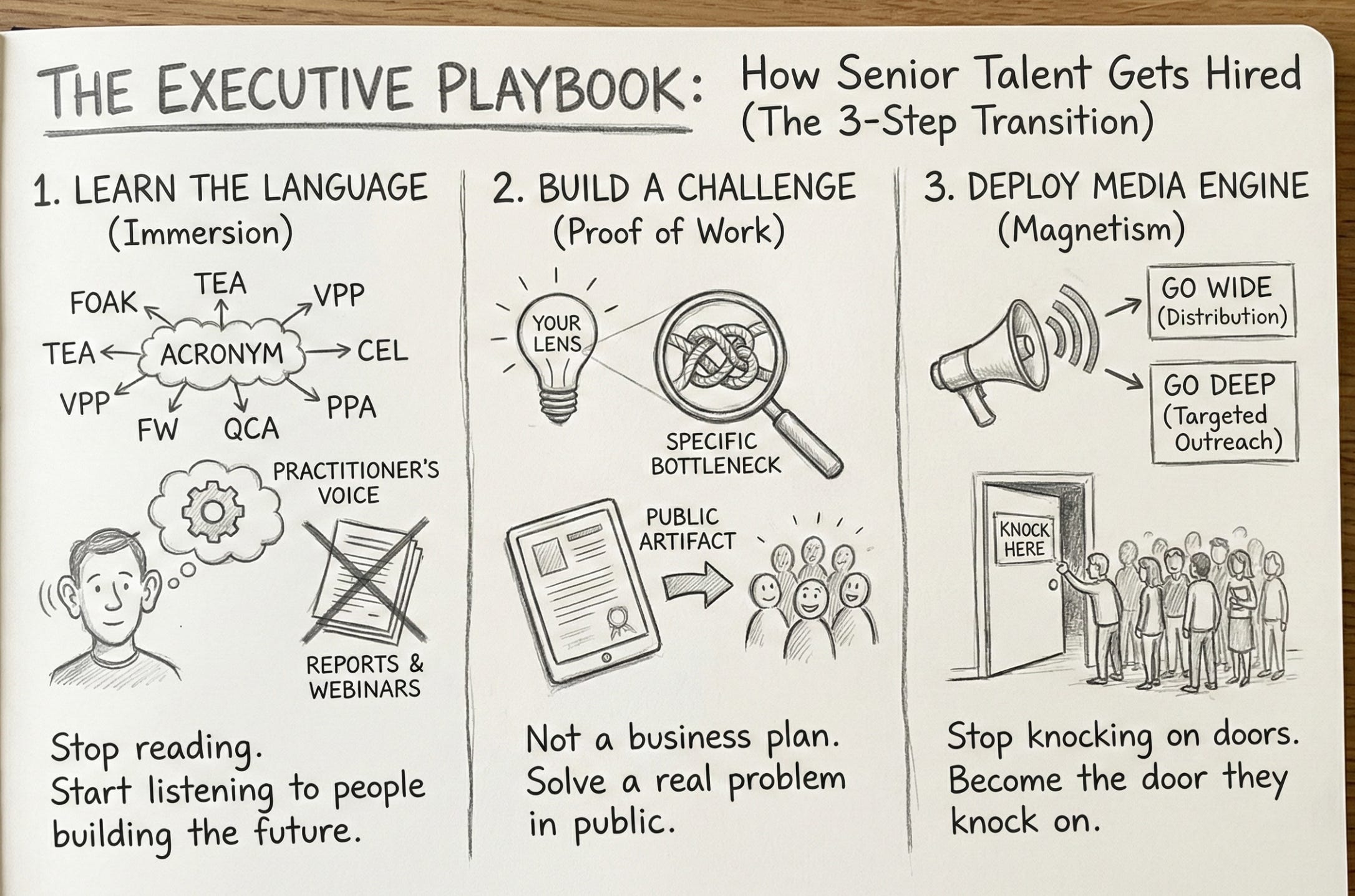
Today I’m going to walk you through the playbook we’ve built at Climate Drift for solving this translation problem. We’ll cover three things:
Learning the Language: How you actually absorb a new sector without going back to school
The Challenge: How you prove you can solve real problems before anyone hires you
The Media Engine: How your work becomes a magnet instead of an application
🌊 Let’s get into it
Our exec program takes a small group of senior operators through the full playbook: learn the language, build a Challenge, deploy it. Direct feedback from me, a cohort of peers with 10+ years of experience, and access to our climate network.
The unfair advantage: we put our entire distribution (10,000+ readers, investor groups, founder circles) behind your work. You bring the expertise. We make sure the right people see it.
[Apply here] if you want in.
The Translation Problem
Here’s something I’ve noticed about career transitions: they fail at the vocabulary stage.
Think about it like moving to a new country. You might be a brilliant surgeon back home. But if you can’t order coffee in the local language, nobody knows you’re a brilliant surgeon. You’re just the person struggling at the counter.
Climate has its own language. It has its own acronyms (FOAK, TEA, VPP, PPA). It has its own tribal knowledge about which problems are actually hard and which ones are solved-but-nobody-knows-yet. It has its own cast of characters—the founders everyone respects, the investors who actually write checks, the operators who’ve seen what works.
You can’t waltz into a new sector and immediately start proposing solutions. Not because your solutions are wrong, but because you haven’t earned the right to be heard yet. You don’t speak the language.
So the first step is immersion.
Step 1: Learning the Language
The way most people try to learn a new industry is broken.
They read reports. They watch webinars. They consume content created for the lowest common denominator. And after three months, they know a lot of facts but they don’t understand the texture. They can’t tell which problems are real and which are PowerPoint problems.
Here’s what actually works: you need to hear practitioners talk about their problems in their own words, unpolished, in real-time.
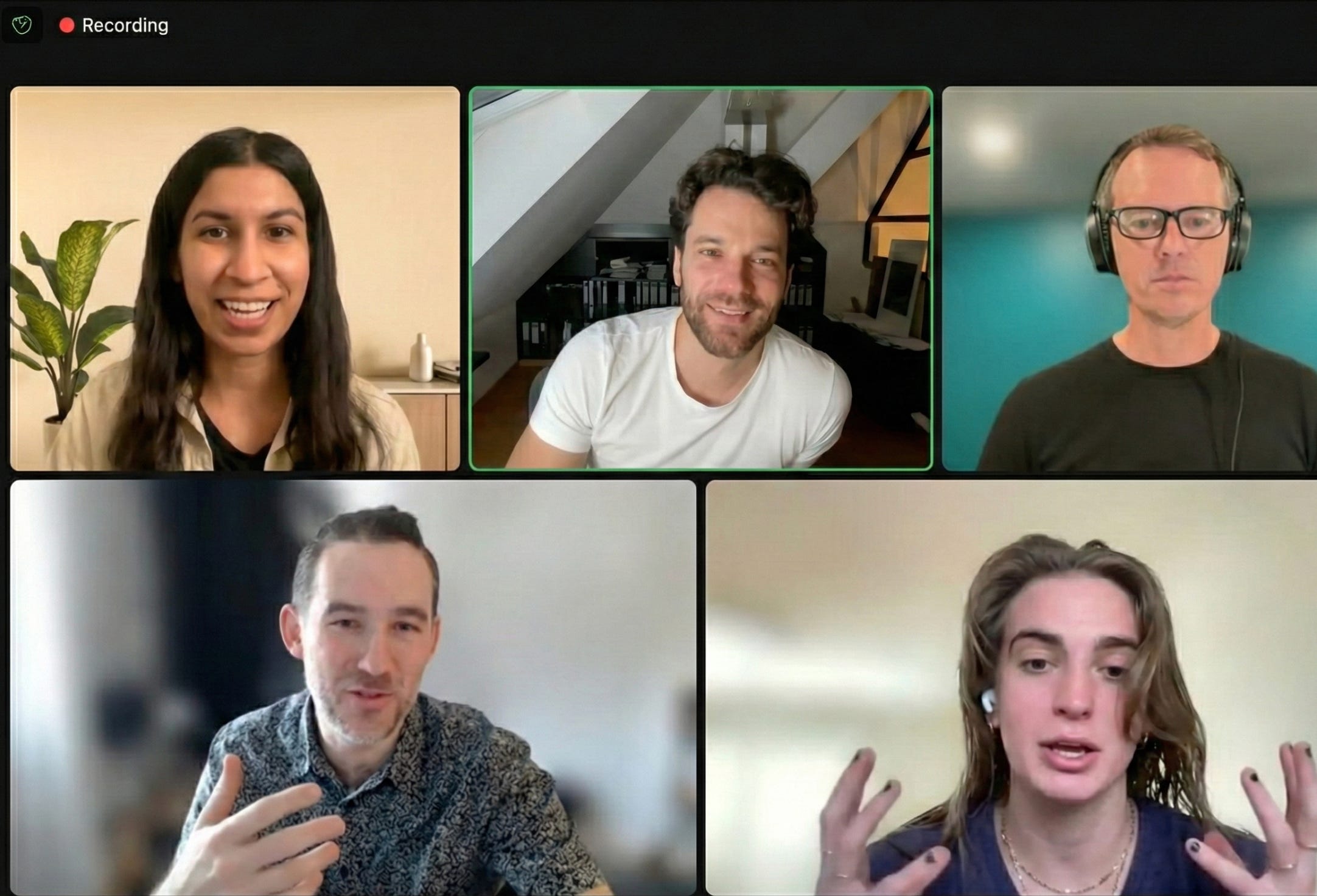
This is what we do in what we call Sector Sprints. Every week, we bring in operators, founders, and investors who are in the middle of building the energy transition. Not professors. Not advocates. People who are writing checks, building factories, and losing sleep over problems they haven’t solved yet.
Gabriel Scheer from Elemental, who’s seen 100+ climate investments through his portfolio. Rushad Nanavatty from Third Derivative, who oversees a massive portfolio of climate tech startups. Johann Boedecker from Pentatonic, who’s built manufacturing tech across Asia. Hege Sæbjørnsen from IKEA, leading global circular strategy for one of the largest consumer footprints on Earth.
These aren’t TED talks. They’re more like the conversations you overhear at the bar after the conference, except we have you be a part of it and you’re allowed to ask questions.
Here’s why this matters: when someone who’s actually building a battery factory talks about their challenges, you’re hearing the real bottlenecks. Not the bottlenecks from a McKinsey slide. The messy, specific, “I can’t find anyone who knows how to do X” bottlenecks.
And that’s when something clicks.
You’re listening to someone describe a coordination nightmare at a heat pump company or somebody talking about the early product obstacles of a massive second-hand furniture marketplace.
And then you think: wait, I’ve solved this exact problem before. Different industry, different context, but same underlying structure.
That’s the moment your experience becomes transferable. Not in theory - in practice. You now know there’s a specific gap where your skills fit.
But here’s the thing: you can’t act on that recognition yet. You heard the problem. You felt the recognition. But you still don’t speak the language well enough to propose your solution in a way that lands.
So you study up. You learn the vocabulary. You start to see the world through the eyes of the people who live there. And then - only then - can you walk up to someone and say: “I think I understand your problem, and here’s how I’d think about it.”
This is language learning the way it actually works. First, grammar and vocabulary (our Monday intro sessions where you learn the landscape). Then, immersion (the mid-week sessions where you hear native speakers describe their reality). Then, real-world practice (asking questions, testing your pitch, seeing what resonates).
You don't become fluent from a textbook. You become fluent from ordering a custom sandwich at a packed counter (hold the mayo, extra pickles, toasted not grilled) and finding out real fast which words you actually know and which ones you just thought you knew.
Step 2: The Challenge
Okay, so you’ve learned the language. You understand the landscape. You’ve identified a bottleneck where your experience might be valuable.
Now what?
In every other context, we understand that proving you can do something is more powerful than claiming you can do something.
Athletes have game tape. Developers have GitHub. Investors have track records.
But for some reason, when it comes to career transitions, people revert to resumes and cover letters. “Please trust that my 15 years of experience will transfer to your context. I promise I’m good.”
This is insane.
Instead, we ask our members to do something we call a “Challenge”. It’s simple in concept: pick a real problem in the space you want to enter, and demonstrate - in public - how you’d think about solving it.
Not a business plan. Not a 50-page strategy deck. A focused piece of work that shows how your mind works when applied to problems this industry actually cares about.
The best Challenges share a few characteristics:
They solve a real problem. Not “thoughts on sustainability.” A specific bottleneck that actual founders and operators lose sleep over. The more specific, the better.
They demonstrate a lens. The value isn’t just information - anyone can Google information. The value is your professional perspective applied to that information. How does someone with 15 years of operational experience see the heat pump deployment problem differently than everyone else?
They target a specific audience. “Climate people” isn’t an audience. “Technical founders who need to do their first Techno-Economic Analysis and have no idea how” is an audience.
They make you findable. LinkedIn link. Calendar link. Make it embarrassingly easy for the right person to reach out.
Let me give you a few examples of how this plays out.
Joseph DeNatale spent years running operations for a wedding band business. Sounds unrelated to climate, right? But when you dig in, what he actually did was build systems to coordinate dozens of artists, handle unpredictable requests, and scale operations from chaos to order.
He joined Climate Drift, learned the language of the heat pump industry, and realized: the reason heat pump deployment is stuck isn’t technology. It’s operational bottlenecks. Nobody has figured out the coordination layer.
He wrote a Challenge about barriers to heat pump deployment in America. Now he’s managing over $1M in active installations at Jetson, one of the largest heat pump companies in the US.
Nick Baumann had spent years scaling COVID testing facilities - a crash course in building First-of-a-Kind infrastructure under impossible constraints. He came to Climate Drift asking “where does this experience fit?”
In every session, he tested his language. He’d bring up his operational background and see how it resonated. He refined his pitch based on what landed. Eventually, he wrote the FOAK Field Guide - a breakdown of how to build and scale first-of-a-kind facilities. He’s now Senior Advisor at Decision Advisory Group.
Mojisola Terry dedicated 10+ years improving lives across Africa through the World Health Organisation. She kept probing and learning about financing tools and insurance. Eventually she wrote her behind-the-scenes post on how climate insurance and parametric tools transform humanitarian response to natural disasters. She’s now the Principal Strategist at the International Rescue Committee.
Tessa Peerless was already working as a chief-of-staff for a carbon neutral cement company, when she published her insider guide to low-carbon cement (booking 13 biz dev leads for her company through it), and followed it up with her deep dive on decarbonizing existing buildings shortly after founding her residential electrification company Dawn Energy.
Jarek Dmowski came from hedge funds and big banks. Every time a speaker talked about fundraising or capital stacks, he took notes. He combined what he was hearing with his finance experience and created a framework for climate fundraising. Now he publishes a widely-read feature at Climate Drift tracking major funding rounds.
Notice what these stories have in common. Nobody started by saying “I want to work in climate.” They started by listening for problems that matched their pattern recognition. They tested their framing in real conversations. They built a public artifact that proved they could think clearly about problems people actually have.
The Challenge isn’t a one-time thing you write and forget. It’s proof of work that lives on the internet forever. It becomes the reason someone forwards your name to their portfolio company six months later. It becomes the thing people reference when they meet you at a conference: “Oh, you’re the person who wrote that piece on X.”
It’s the difference between knocking on doors and becoming a door that people knock on.
Learn more about the challenge in our deep dive here:

Step 3: The Media Engine
Here’s where most “build in public” advice falls apart.
People write something good, post it once, and then... nothing. It sits there. Maybe a few likes. Maybe one share. Then the algorithm moves on and their work disappears.
For a senior executive who just spent 20 hours on a serious piece of analysis, this is demoralizing. It feels like shouting into the void.
This is why we built what we call the Media Engine. Think of it as a marketing agency that works for you.
It has two components: (1) going wide and (2) going deep.
1. Going wide means we put our distribution behind your Challenge. Climate Drift has over 10,000 readers—founders, investors, operators actively building in this space. When your Challenge is good, we feature it. Your thinking goes directly to the people who need to see it.
This isn’t charity. Good Challenges are genuinely valuable content for our audience. We’re not doing you a favor; we’re sharing work that our readers want to read.

2. Going deep means targeted outreach. Once you have a Challenge, you have something to send. Not “hey, can we jump on a call?” but “I spent a month going deep on your market, here’s what I found.”
Jonathan Castrodale used his Sustainable Aviation Fuel breakdown to email 150 industry players. He wasn’t asking for a job. He was providing value. That shift in posture - from “favor asker” to contributor - is why he’s now Director of Renewable Fuels at Earth Finance.
Laura van Meer, an ex-Airbnb operator, applied hospitality thinking to climate tech with a guide on ambassador programs. Four companies booked calls within 30 minutes of it going live.
The compounding effect is the part people underestimate.
Your Challenge isn’t a one-shot application that either works or evaporates. It’s an asset that keeps working. VCs forward it to portfolio companies. People search for it when they’re hiring for roles in your niche. Someone reads it six months later and reaches out because they finally have the budget.
One member told us they became a “walking billboard” for their own expertise - everyone they met at in-person events already knew their work through the Climate Drift network.
This is what real career leverage looks like. Not optimizing your resume. Building a body of work that compounds.
The Playbook
Let me bring this all together.
The energy transition is the largest infrastructure buildout in human history. It needs people who know how to build things, scale operations, structure deals, manage complexity. Those people exist - they’re just stuck in translation.
The playbook is simple:
Learn the language. Immerse yourself in real conversations with practitioners. Listen for problems that match your pattern recognition.
Build a Challenge. Prove you can think clearly about problems people actually have. Make it specific. Make it public.
Deploy the Media Engine. Go wide through our distribution. Go deep through targeted outreach. Let your work compound.
We’re not promising magic. This is work. You have to show up, do the reps, and produce something worth reading.
But if you’re a senior operator who’s tired of the job-search-industrial complex, tired of feeling like your 15 years of experience doesn’t translate - there’s a better way.
We’re currently accepting applications for the next cohort of the Climate Drift Executive Program (12 weeks, 5-15 hours of work per week). Because we provide multiple 1-on-1 sessions to refine your Challenge and distribution strategy, spots are limited.
Apply to the Executive Program here →
The energy transition won’t be built by people who are “passionate about sustainability.” It’ll be built by people who know how to build things. Time to act.
Aloha,
Marco & Skander
PS. Here are a few questions we received a lot + our answers:
1. “I am already at 100% capacity. Can I actually do this?”
We’ve had members successfully navigate our program while working on the Paris Olympics, dealing with sudden layoffs, hurricane evacuations of their families, and even balancing a newborn.
We don’t think of this as “extra work.” We think of it as replacing the 20 hours a month you currently waste “shouting into the void” via standard job applications that disappear into hiring black holes.
For many, the predictability of sessions and “being held to a high standard” by peers (10+ years of experience) was exactly what was required to finally get serious about a transition.
2. “I am not a ‘writer’ or a ‘LinkedIn person.’ Does this still work?”
We aren’t training you to be an influencer; we are training you to be legible.
Many of our most successful “Drifties”, started with a “mild fear of LinkedIn” (we even launched a “thought leadership for humans” course on that topic and published a guide on how to do thought leadership right), but all agreed that they needed to be pushed outside their comfort zone.
And that’s where the real learning and transformation started. LinkedIn post and profile overhauls immediately paid off in inbound outreach and establishing credibility.
3. “Why wouldn’t I just get a Sustainability Master’s degree?”
We have several members who spent a year in a “terribly expensive sustainability masters” at [redacted] University. Finding that traditional career centers at universities are often oriented toward people early in their careers, not 10+ year senior switchers.
But the real difference? Learning from people in the trenches and hearing what needs solving in the next 6 months and what skills are needed today. Instead of an academic curricula that mattered yesterday, so by the time you graduate you’re already a year behind in a sector that evolves by the quarter, not the decade.
As Vianney Brandicourt (ex-Spotify/Google) put it to us, “this program is significantly more practical and impactful than other fellowships”.
4. “What if the price is a barrier for me right now?”
We are obsessive about the quality of our cohorts. We look for talent, perspective, and drive above all else.
Price should never be the reason the right person doesn’t join the table. We offer scholarships and flexible options to ensure that a temporary budget crunch doesn’t define your worth.
If you know you are the right fit but the investment is an obstacle, apply anyway. Let’s start the conversation and see how we can help you make the leap.