

The Climate Drift guide to thought leadership (that doesn't make you cringe)
A framework to identify your type, design sustainable experiments, and turn visibility into impact

👋 Welcome to Climate Drift: The climate transition is happening faster than you think. We cover the companies, deals, and people building it. For operators, founders, and investors who want in. Community | Accelerator | Open Climate Firesides | Deep Dives
Hey there! 👋
Skander here.
You know that speaking up about your work could accelerate your career, attract partners, and advance the causes you care about. And yet... something holds you back.
That something usually has a name: cringe.
We’ve all seen the worst of LinkedIn. The humble-brags dressed as insights. The manufactured vulnerability. The “I was sitting in a coffee shop when I realized...” posts that feel less like wisdom and more like performance art for engagement metrics.
But here’s the thing: every week you stay silent, someone less qualified is shaping the conversation you should be leading.
That’s not a guilt trip. It’s just what happens when thoughtful people opt out because “thought leadership” sounds like something that requires a ring light and a personality disorder.
So we asked driftie Katie Gilbert to give us a guide: A framework to find your voice, pick your format, and start without hating yourself.
🌊 Let’s dive in
But first: Who is Katie?
She’s a Philadelphia-based writer, editor, and educator with over 20 years of experience, and a longtime focus on climate and social impact. As a journalist, she’s covered sustainable finance for Institutional Investor and Responsible Investor, and her longform feature on an economic and political experiment in Jackson, Mississippi was one of Oxford American’s most-viral stories of the year. Her journalism has also been published in The Atlantic, Al Jazeera America, Psychology Today, and elsewhere.
She works with universities, brands, and mission-driven organizations to connect their people’s ideas to wider audiences. Current and past clients include Stanford Insights, Columbia Business Magazine, Yale School of Management’s Yale Insights, and impact investing nonprofit ImpactAssets.
Katie also teaches a writing course for visual art students at Massachusetts College of Art and Design, and she previously taught journalism at Manhattanville College in New York.
Starting mid February, Katie will be running a six-week program inside Climate Drift called Thought Leadership for Humans.
Think of Thought Leadership for Humans as a classroom, lab, and community space rolled into one. The goal: equip would-be climate leaders with the structures, processes, inspiration, and feedback they need to finally step into their own voices.
Each week of the program will include an lesson to kick off the theme of the week; two live calls; visits from guest experts (including investors, established thought leaders, and content-strategy experts); show-and-tell sessions where cohort members get feedback on projects-in-process; and weekly challenges to get participants sharing publicly, right away.

The Climate Drift guide to thought leadership (that doesn’t make you cringe)
Generative vs. Extractive thought leadership
In her book Owning Our Future, researcher Marjorie Kelly distinguishes between a generative economy (one whose fundamental architecture creates beneficial outcomes for all life) and an extractive economy (one that prioritizes maximum physical and financial extraction for the benefit of a few).
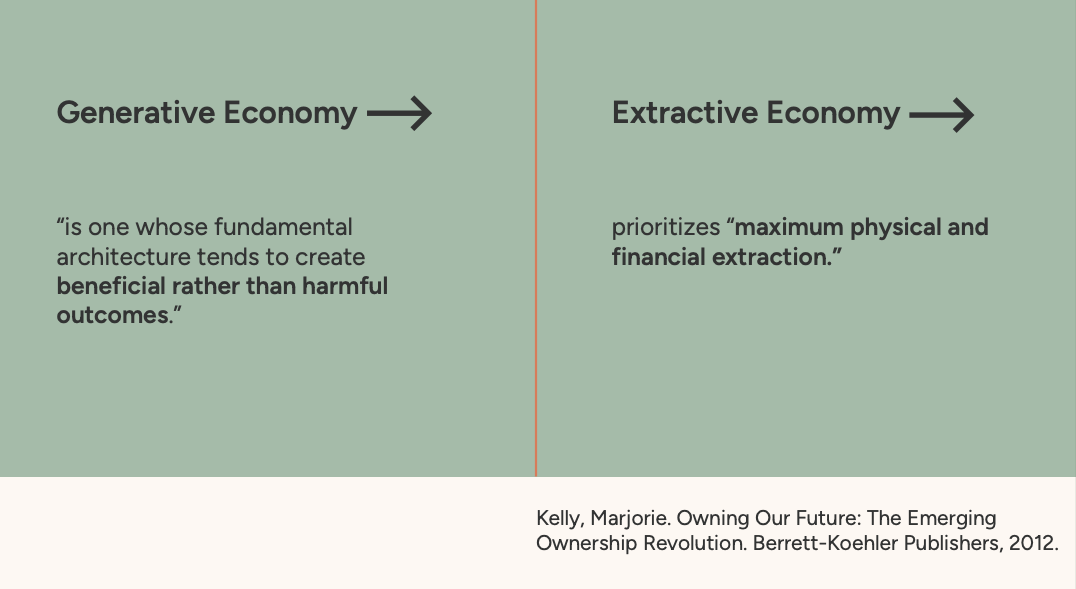
What if we applied the same framework to thought leadership?
Extractive thought leadership is designed for maximum extraction of attention, emotion, and money to benefit one person. It’s the endless self-promotion. The shock value. The emotional manipulation wrapped in “authenticity.”
Generative thought leadership is content designed to bring about beneficial outcomes for many. It educates. It connects. It advances collective understanding.
The distinction matters because it changes the question from “How do I promote myself?” to “How do I provide value to others?”
And once you make that shift, something interesting happens: The cringe evaporates.
What you’re sitting out on
Before we get tactical, let’s be clear about the stakes. When you avoid speaking publicly about your work, you’re leaving these benefits on the table:
Trust and familiarity. Warm leads for your business. Future partners who already understand what you’re building.
Inbound opportunities. Media appearances, podcast invitations, job offers—these don’t typically come from cold outreach. They come from people who’ve already been following your thinking.
Idea refinement. Every time you articulate your thesis publicly, you start feedback loops that sharpen your understanding. The act of explaining forces clarity.
Advocacy. If you care about climate solutions, your silence is a strategic choice—and possibly not the right one.
The Six Archetypes
Here’s where it gets practical. There are six distinct archetypes for thought leaders. Most people resonate with one or two, and that resonance points to the type of content you’ll actually sustain.
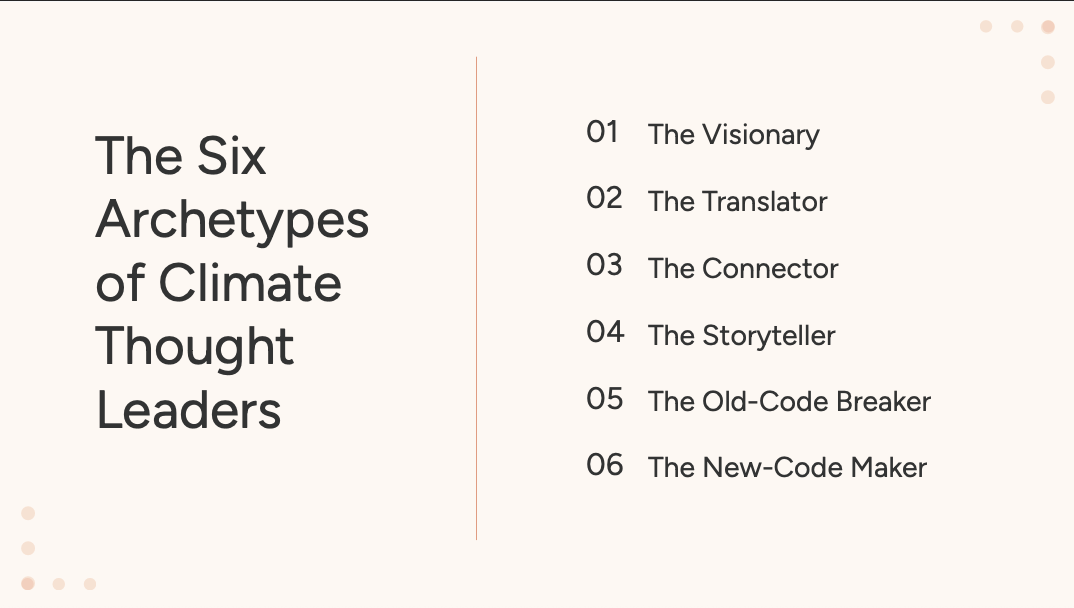
1. The Visionary
Core drive: Paint a vivid picture of a better climate future and present a roadmap to get there.
Who this fits: Founders raising capital. Policy advocates. Leaders who need to rally teams around a bold thesis.
Content formats: Manifestos. “Future of X” essays. Keynotes that synthesize across policy, tech, and markets.
Example: Tessa Peerless, founder of a Canadian residential electrification company, posts a weekly Substack on why Canada’s future is electric—then breaks each post into shorter LinkedIn content. She was deeply uncomfortable starting. Now she’s seeing viral engagement and warm leads flowing in.
2. The Translator
Core drive: Turn complex climate science, policy, or finance into clear, actionable narratives for non-experts.
Who this fits: Corporate sustainability professionals. Climate finance experts. Researchers seeking to influence policy.
Content formats: Explainers. Decision guides. Content that connects data to specific investment or operational decisions.
Example: Daniel Swain, a climate scientist, runs weekly “public office hours“ on his Weather West YouTube channel explaining California weather systems and their climate change implications. Katharine Hayhoe, another climate scientist, excels at metaphors—like her point that climate change is “the hole in the bucket of every other issue.”
The gift of translators is often finding the right metaphor.
3. The Connector
Core drive: Connect people, sectors, or ideas that rarely talk to each other—unlocking new coalitions and possibilities.
Who this fits: Ecosystem builders. Event conveners. Local government and NGO leaders. Anyone who naturally sits between worlds.
Content formats: Case studies of cross-sector projects. Panels that bring people into conversation. Intros on LinkedIn that build community. Events designed for serendipitous collisions.
Example: Nate Burola started The Climate Code, a newsletter that brings AI and environmental challenges into conversation—an interdisciplinary connection not yet getting enough airtime.
4. The Storyteller
Core drive: Make climate challenges and solutions real through human stories. Focus on lived experience and outcomes.
Who this fits: Community organizers. Business owners. Practitioners implementing solutions on the ground.
Content formats: Profiles of workers, residents, customers. Before-and-after narratives. Visual storytelling. Day-in-the-life case studies.
Example: Artist Eve Mosher organized HighWaterLine, a participatory performance in cities worldwide where people drew chalk lines around areas vulnerable to storm surges and flooding. The walks included place-based storytelling to make climate risk tangible.
On the corporate side, Watershed produces customer case studies that include genuine narrative alongside the metrics—how did people actually do this, and who did it affect?
5. The Old-Code Breaker
Core drive: Surface stale narratives and harmful practices that need to end—then offer better alternatives.
Who this fits: Innovators with contrarian insights. Founders disrupting incumbents. Insiders pushing for reform from within legacy institutions.
Content formats: “Myths vs. realities” posts. Critiques of common approaches. Serialized accounts of replacing old systems with better ones.
Example: Manuela Zoninsein, co-founder of Kadeya (maker of closed-loop beverage systems), hosts a podcast called Unbottled that documents building the company while confronting the incumbent bottle industry’s resistance to change. They’re breaking an old code while showing a better way forward.
In an example from the corporate world, Patagonia’s recent sustainability report declared: “Nothing we do is sustainable.” By breaking the code of what sustainability reports typically look like, they signaled authenticity and transparency.
6. The New-Code Maker
Core drive: Codify lessons into repeatable playbooks others can use to accelerate impact.
Who this fits: Operators who’ve implemented solutions repeatedly and want to be known for a specific methodology. Close observers and educators with insights to share.
Content formats: Step-by-step guides. Templates and checklists. “Here’s exactly how we did it” breakdowns.
Example: Vojtech Vasek, a circular economist, writes The Loop newsletter to break down how to go circular.
The trap for this archetype is staying too generic. There’s endless “follow these 5 steps” content out there. Yours becomes valuable when your real depth of experience shines through.
Finding your type
Most people aren’t purely one archetype. You might be a Translator-Storyteller (using stories to translate between worlds) or a Visionary-Code Breaker (challenging old paradigms while presenting new futures).
Here’s a simple exercise: Which two types feel most natural? Which feels like a stretch you’d want to grow into?
Your natural type is where you start. Your stretch type is where you might evolve.
The tiny experiment mindset
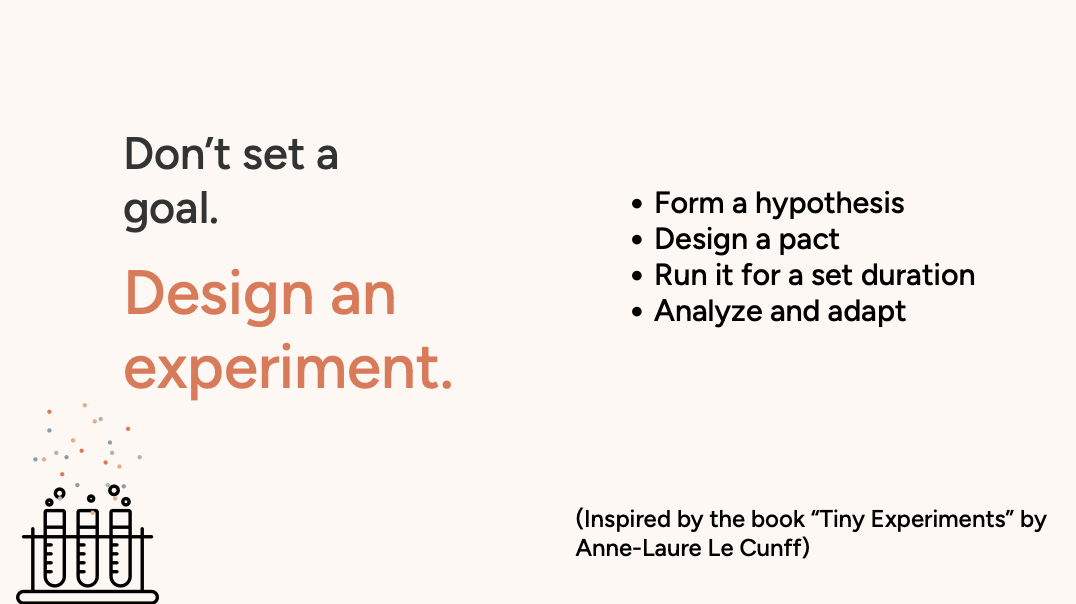
Here’s the mindset shift that makes this sustainable: Don’t set goals. Design experiments.
A goal has a finish line and that finish line often becomes “perfection.” You set out to post once a week, miss a week, feel like you’ve failed, and quit.
An experiment is different. It has a hypothesis, a defined duration, and always results in an outcome to analyze and learn from, regardless of whether it “worked.”
Form a hypothesis: “If I post on LinkedIn once a week showcasing case studies, I’ll start receiving inbound messages from potential clients.”
Design a pact: “I will post every Tuesday for the next two months. I won’t deviate even if engagement is low—that’s data, not failure.”
Run it. Don’t stop early because it feels uncomfortable or because something unexpected happened.
Analyze and iterate. What did you learn? What will you do differently next time? Design another experiment.
This framing lowers the stakes and removes the pressure. You’re not trying to become a “thought leader.” You’re running a two-month experiment, just to see what happens.
Practical Next Steps by Archetype
Wherever you start, these foundations apply to everyone:
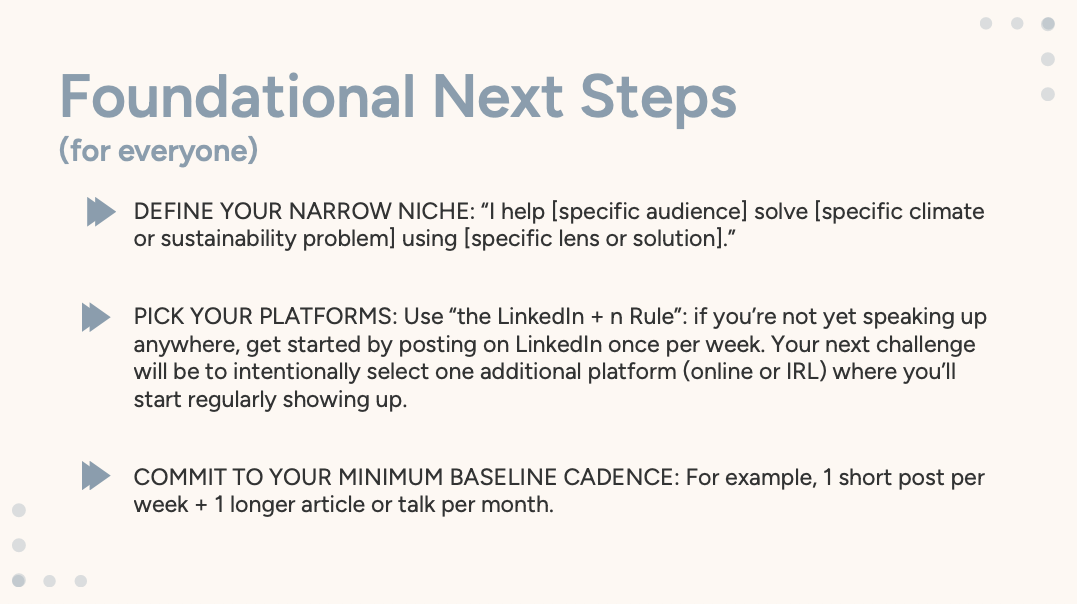
Define your audience. Complete this sentence: “I help [specific audience] solve [specific climate problem] using [specific lens or solution].”
Pick your platforms. Start with LinkedIn plus one other channel—maybe a newsletter, maybe convening small events, maybe pitching op-eds.
Set a minimum baseline. What’s the smallest commitment your brain can’t object to? Is it one short post per week? Then start there.
Then, depending on your archetype:
Visionaries: Write a one-sentence “future of” statement. “In 10 years, [domain] will look like X because Y.” List 3-5 non-obvious implications for your target audience. That’s your content roadmap.
Translators: Choose 1-2 types of complexity you’ll specialize in translating. Develop a standard briefing template you can reuse. Build a reference library of key charts, stats, and explainers.
Connectors: List 3-5 communities you sit between. Identify communication gaps between them. Choose a recurring format (virtual salons, local meetups, intros on LinkedIn) to get them talking to one another.
Storytellers: List 10-15 people, projects, or places whose stories you want to tell. Choose a medium. Develop a recurring format: “Before/during/after” or “Meet so-and-so/their challenge/the solution.”
Old-Code Breakers: List what’s bothering you in your niche. What’s incomplete, outdated, or harmful? Structure every piece around: what people think → what’s missing → a better way forward. Decide in advance how you’ll handle pushback.
New-Code Makers: What’s one transformation you can deliver reliably? Write down the 5-7 key steps as if explaining to an eighth grader. Turn it into a one-page checklist others can use. Run a small workshop. Gather testimonials.
The Compounding Returns
Here’s what most people underestimate: thought leadership compounds.
That post you write this week might get 12 likes. But one of those 12 people might be an investor who remembers your name six months later. Or a journalist looking for a source. Or a potential co-founder.
The connections you make aren’t just additive—they’re multiplicative. Each piece of content, each relationship, each public articulation of your ideas increases the surface area for serendipity.
Tessa Peerless was uncomfortable starting. A few months later, she’s seeing results she couldn’t have predicted. The only difference between her and everyone else who “thought about starting a newsletter” is that she actually ran the experiment.
Your turn.
We are continuing this in our next cohort
The Thought Leadership for Humans cohort will jump right in by learning how to design their own tiny experiments. From there, participants will continually refine their experiments over the six weeks of the program, as they do deep dives into audience targeting, the key elements of great thought leadership, common mindset blocks, and the core tenets of content strategy (streamlined for thought leaders).
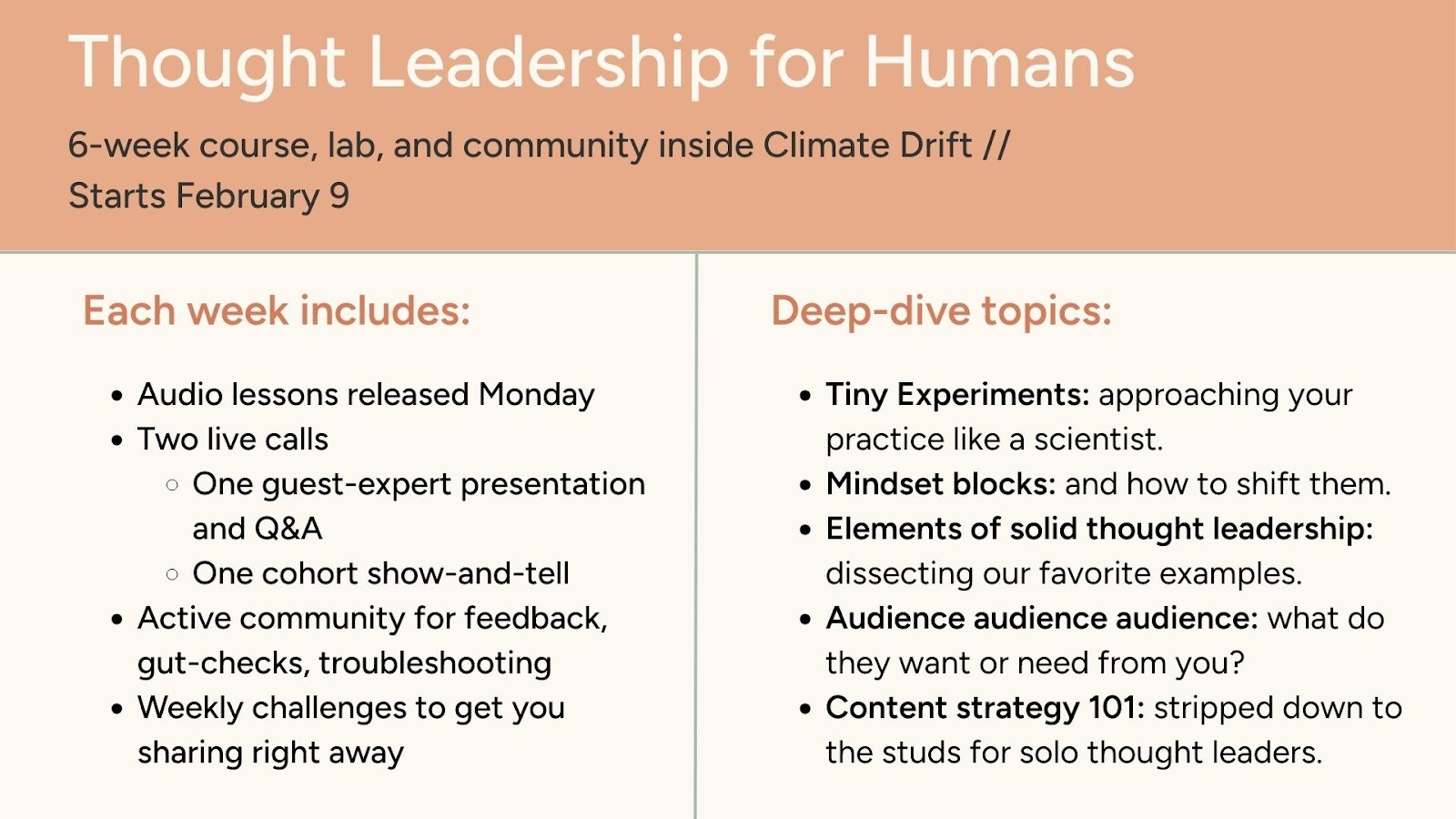
Our next cohort starts February 2026.
Spots are limited, and early applicants will receive priority.
 | A guest post by
|